Ranked #230 car in the UK · Saloon (EV) · 375 units sold last year

Mercedes-Benz EQS

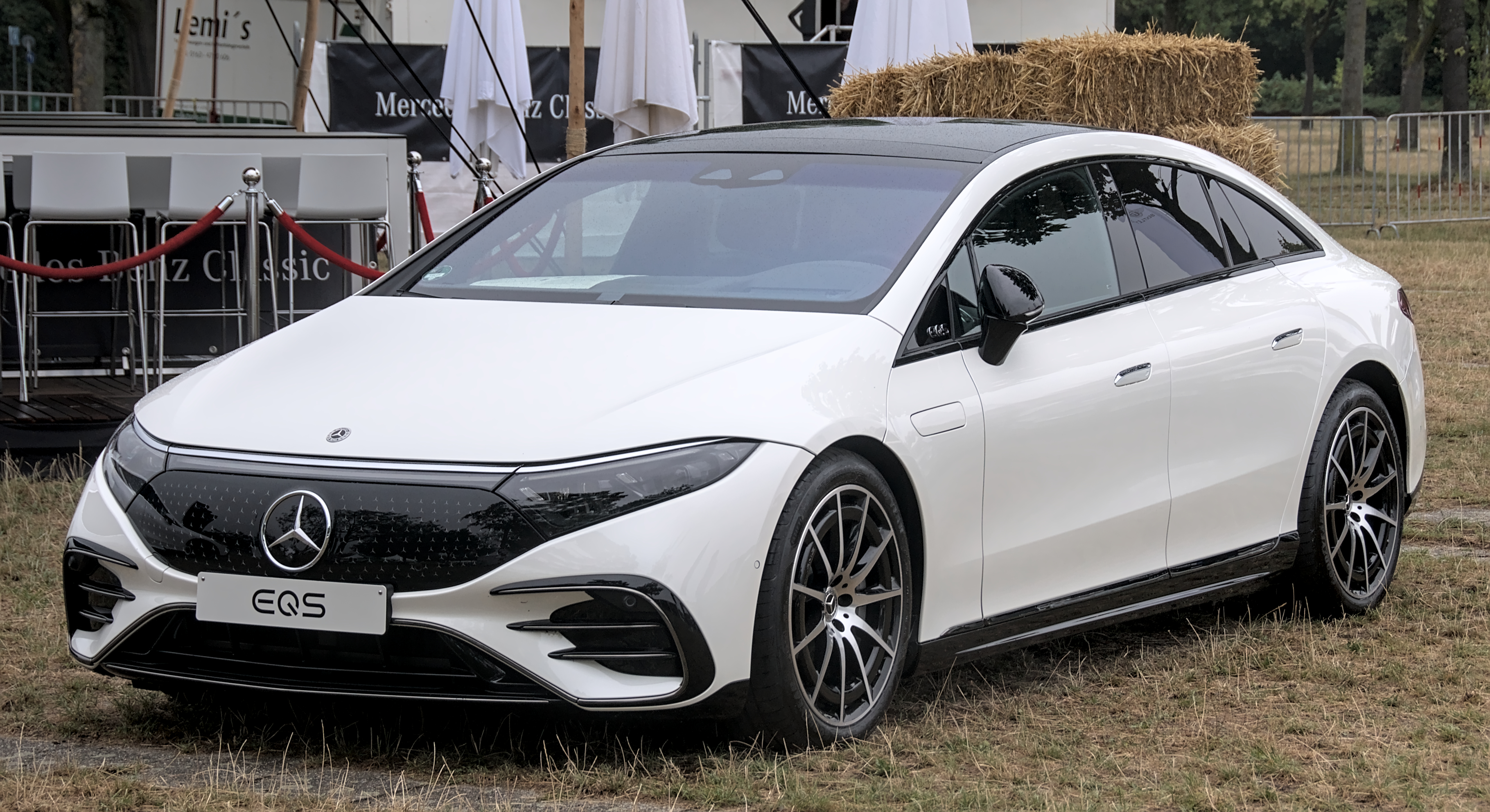
The Mercedes EQS (2022 on) is the all-electric S-Class equivalent - a hushed, ultra-long-range luxury saloon with one of the biggest batteries on the market and a cabin dominated by the sweeping Hyperscreen. It floats rather than handles, prioritising serenity and range above all. As a used electric flagship it offers limousine comfort and genuine long-distance ability, though depreciation has been steep - which makes it a used bargain.

How these figures are sourced the valuation is anchored to a researched used-market price for this model (AutoTrader median, 2023 at 30k miles). Reliability, mileage and variant data are real DVSA MOT records. Dimensions, tyre sizes and costs, servicing figures and the insurance group are segment-level estimates rather than sourced per car, and are being replaced model by model.

Mercedes-Benz EQS
Photo: Alexander Migl via Wikimedia Commons · CC BY-SA 4.0 · source
Body
Saloon (EV)
Years
2022–2026
Fuel
Electric
Efficiency
3.4 mi/kWh

typical

Insurance
Group 46

The short version

20/100

Forecourt score

Value 9 · Reliability 40 · Insurance 4 · catalogue percentiles

The Mercedes-Benz EQS loses value faster than most cars and is dearer to run than most. Its MOT-based reliability is good — an MOT score of 74/100. On three-year value retention it ranks better than 9% of models.

The Forecourt score blends how this car ranks against the catalogue on value retention, reliability and insurance cost (weighted 40/40/20) — the from-new ownership picture. Higher is better; running cost is not yet folded in.

Pick your version

Estimates are tuned to the version you choose.

Fuel

Electric

Power

360 ps

Drivetrain

RWD

Efficiency

3.4 mi/kWh

The volume EQS saloon - the electric S-Class. 118 kWh, 360 PS RWD, ~481 mi WLTP (one of the longest-range EVs on sale). Heat pump standard; 200 kW DC.

Tell us about the one you're looking at

2023
20222026
34,344 mi
0Expected: 34,344180k
good
PoorFairGoodExcellent

Tidy and well looked-after for its age — the typical car.

Remembered as you browse other cars.

Optional — fills in the exact year and ULEZ status for your specific car. The registration isn’t stored.

Estimated market value

How we got this number — click for the breakdown, or to challenge it.

£49,250

Range £40,250£58,900

medium confidence

When new (2023)circa £105,000Age-based value£50,715Mileage adjustment+£0Condition & region+£20Market calibration+£865Forecourt price£51,600Private sale£46,900Part-exchange£41,300
Holdthis 3-year-old

Fair value — depreciation is moderating.

At 34,344 miles it’s about the ~33,608 typical for a 3-year-old.

Seen one for sale?

£

A data-led guide from the depreciation curve, UK parc trend and reliability — not financial advice.

The depreciation curve

How a 2023-registration Mercedes-Benz EQS loses value over time.

What it costs to own

Over

Based on the 2023 car with 34,344 miles you entered above — worth about £49,250 today — here is the cost of owning it for the next 5 years, at roughly 11,448 miles a year.

5-year total

£25,067

Per year

£5,013

All-in per mile

£0.44

Fuel per mile

7.9p

If a company carAround £158/mo Benefit-in-Kind tax at the 40% rate (£79/mo at 20%) — 4% band (EV)

Depreciation£10,501
Fuel / energy£4,546
Servicing£2,570
Road tax£1,000
Insurance£6,450

If you're a company-car driver

At 4% BIK, this would cost a 40% taxpayer about £158/month in company-car tax (£79/month at 20%) — one of the strongest cases for choosing an EV via salary sacrifice. Full BIK table below for context.

Best age to buy — around 2 years

A 2-year-old example loses roughly £9,400 a year — 79% less than the £45,450 a one-year-old sheds. The steepest drop is behind it.

Uses current UK pump and home-charging prices (DESNZ weekly), typical-driver insurance and manufacturer service intervals. "Fuel per mile" is just the energy input — so an EV at ~9p and a diesel at ~22p make running-cost comparison direct. A guide; your own costs will vary.

How it compares

Where this car ranks against the 340 vehicles in our index — higher is better.

Holds its valuebetter than 9%
Reliabilitybetter than 40%
Cheap to insurebetter than 4%

Percentile rank across our full index. A measure is shown only where the data spreads meaningfully across the index.

Petrol, diesel, hybrid or EV?

How the available versions compare on price, running cost, and the headaches each tends to develop.

EQS 450+ / 450 4MATIC

Electric S-Class. Class-leading 481mi WLTP. Hyperscreen is a 56-inch span of glass that genuinely transforms cabin tech. Cross-shop BMW i7, Audi e-tron GT, Lucid Air. Mercedes brand 2nd of 31 in 2025 Driver Power.

New price
circa £115,000
Annual fuel / energy
£1,100
3-yr depreciation
53%

Watch for

  • ·MBUX Hyperscreen software complexity (improving via OTA)
  • ·Air suspension compressor at high mileage
  • ·12V battery drain when parked
  • ·'Spaceship' styling polarising — divisive vs traditional saloon shapes

EQS 580 / AMG EQS 53

EQS 580 the comfortable AWD flagship. AMG EQS 53 the performance variant but less track-focused than e-tron GT RS or Taycan Turbo. The EQS is best at quietly cruising — that's where it shines.

New price
circa £150,000
Annual fuel / energy
£1,200
3-yr depreciation
54%

Watch for

  • ·Same software / suspension complexity
  • ·AMG: tyres wear quick
  • ·Heavy (~2.6 tonnes)

Fuel/energy costs based on this week’s UK averages (w/c 03/08/2026) · Petrol 159.9p/L, Diesel 179.2p/L, Electricity 27.0p/kWh · DESNZ

Estimated insurance

Group 46 of 50 (very high — top of the scale) · Comprehensive · 3 years NCB

Indicative annual comprehensive premiums for this car, by driver age band and risk profile. Pick the combination closest to your circumstances.

3 years
0 yearsBaseline: 3 years15+
Risk profile:

Estimated annual premium · typical, age 33-39

£1,290/ year

Roughly £108 per month

Typical

Average UK driver — 3 years NCB, average postcode, no recent claims.
Age bandLower riskTypicalHigher risk
Age 17-25£2,941£3,677£4,779
Age 26-32£1,535£1,806£2,203
Age 33-39Selected£1,135£1,290£1,522
Age 40-49£964£1,071£1,242
Age 50+£859£955£1,126

How we estimate this

Indicative annual comprehensive premium estimates. The 'Typical' figure represents an average UK driver in each age band; Lower and Higher risk show the realistic spread driven by factors UK insurers legitimately price on (postcode, occupation, claims history, NCB, voluntary excess, modifications). Based on 10,000 miles/yr, £250 voluntary excess, and the no-claims bonus selected above. Always get individual quotes before buying.

Expected annual costs

Adjust the annual mileage to match how you'll actually use the car. Insurance is what you selected above (age 33-39, typical risk, 3 yrs NCB).

11,448 mi/yr
2,000UK avg for this model: 11,44830,000

Routine service

£290

Annual main-dealer service

Major service

£280

Every 2 years, annualised

Road tax

£200

Standard rate, post year-one

Electricity

£909

3.4 mi/kWh, 27p blended

Insurance

£1,290

Age 33-39, group 46

Clean-air zones

ULEZ compliant
  • Electric variants are compliant with London ULEZ and all UK clean-air zones.

Based on London ULEZ standards — Birmingham, Bath, Bristol, Sheffield, Glasgow and other UK clean-air zones generally follow the same rules.

Total expected£2,969 / year

Excludes depreciation and unscheduled repairs (see next section).

Unexpected costs

What out-of-warranty repairs typically run, by mileage band. Your selected mileage is highlighted.

0-30k miles

£120

per year · low risk

30-60k miles

£360

per year · low risk

60-100k miles

£780

per year · medium risk

100k+ miles

£1,350

per year · high risk

Tyres

205/60 R16 · 225/50 R17 · 245/40 R18

What a full set of four will cost you (including fit and balance), and which brand each tier of buyer should pick. A typical set lasts about 24,000 miles.

Budget

£300

set of 4, fitted · £60 per tyre

Mid-range

£440

set of 4, fitted · £95 per tyre

Premium

£620

set of 4, fitted · £140 per tyre

What to fit

Optional extras worth paying for

Factory options ranked by how much of their original cost they recover at resale. Anything above 70% return tends to make money back; below 40% is paying for your own enjoyment.

OptionNew costAdded used valueReturn

Tow bar (factory-fit)

Niche, but the buyers who want one will pay for it.

£650£45069%

Parking sensors & reversing camera

Near-expected now — its absence costs more than its presence returns.

£500£30060%

Heat pump

Genuinely useful in winter; buyers increasingly look for it.

£1,000£45045%

Heated seats / cold-weather pack

£450£20044%

Adaptive / matrix LED headlights

£900£40044%

Faster on-board AC charger

£800£30038%

Metallic or premium paint

Almost universal — an unusual colour is the bigger resale risk.

£600£20033%

Panoramic / opening roof

£1,100£35032%

Advanced driver-assistance pack

£1,500£45030%

Larger alloy wheels

£700£20029%

Premium sound system

£800£20025%

Parts most likely to fail

Drawn from owner reports and warranty data. Filtered for relevance to 34,344 miles.

Watch now

Failure typically happens around your current mileage.

Upcoming

A known weak point — but you haven't reached its usual mileage yet.

Already due

Past its usual failure mileage. Either already fixed, or about to.

Tyres & wheelsUpcoming

Typical at 60k-100k milesCost £80-£500medium severityParts high

Recorded in 7.8% of MOT tests 60k-100k miles — from 3,573 DVSA MOT tests analysed.

SuspensionUpcoming

Typical at 60k-100k milesCost £150-£450low severityParts high

Recorded in 1.0% of MOT tests 60k-100k miles — from 3,573 DVSA MOT tests analysed.

Driver's viewUpcoming

Typical at 60k-100k milesCost £60-£300low severityParts high

Recorded in 0.5% of MOT tests 60k-100k miles — from 3,573 DVSA MOT tests analysed.

BrakesWatch now

Typical at 30k-60k milesCost £150-£500medium severityParts high

Recorded in 0.3% of MOT tests 30k-60k miles — from 3,573 DVSA MOT tests analysed.

Identification & otherWatch now

Typical at under 30k milesCost £20-£150low severityParts high

Recorded in 0.2% of MOT tests under 30k miles — from 3,573 DVSA MOT tests analysed.

Body & structureWatch now

Typical at under 30k milesCost £200-£1,200low severityParts high

Recorded in 0.2% of MOT tests under 30k miles — from 3,573 DVSA MOT tests analysed.

"Parts low/medium/high" indicates how easy the replacement part is to source — discontinued or specialist parts mean longer workshop time and bigger bills.

Safety rating

Euro NCAP's independent crash-test rating for the Mercedes-Benz EQS, from its 2021 assessment.

5/5
TEST YEAR2021
Current rating · valid to 2027

The passenger compartment of the EQS remained stable in the frontal offset test.

Independent crash-test data from Euro NCAP. Star ratings reflect the test protocol of the year shown — newer protocols are stricter, so a 5-star from 2024 represents a higher bar than a 5-star from 2014. Euro NCAP ratings run for six years from publication; a lapsed rating means the protocol has moved on, not that the car performs any worse than it did on test.

MOT outlook

How this model fares at its MOT as it ages — from 3,847 real DVSA test records.

MOT pass rate by age

A 3-year-old EQS passes its MOT 89.9% of the time; by 4 years that has slipped to 87.8%. The y-axis is zoomed to this model’s range so the trend is readable.

Longevity

Not enough older examples yet to gauge longevity.

What fails at the first MOT

The defect categories a EQS registered 2021–2023 fails on at its first MOT, from 1,130 first tests. Every car here is the same age and the same generation, so these are the faults that show up first - not the wear a high-mileage older example collects.

  • Tyres & wheels8.3%
  • Suspension1.2%
  • Driver's view0.4%
  • Identification & other0.3%
  • Body & structure0.2%
  • Brakes0.2%

Share of first MOT tests recording at least one defect in that category. DVSA test-item categories, not parts: “Driver’s view” covers mirrors, wipers and glass.

Typical mileage by age

The average odometer reading for a EQS at MOT, by age — measured from the same DVSA records, not assumed. A useful yardstick for whether a given car has done more or fewer miles than its age suggests.

  • 3 yr33,608
  • 4 yr44,197

Mean recorded mileage at MOT by vehicle age, from DVSA test records. Ages below three are not shown: the first MOT is due at three years, so the few cars tested earlier are a self-selected minority rather than a representative sample. Ages with at least 10 tests shown.

Reliability

74/ 100

Good

First-MOT pass rate and defect rate for cars registered 2020 onward (1,130 first tests), with cohort survival — medium confidence.

MOT outlook

Insufficient MOT history at this car's reference age — too few tests to compute a reliable percentile.

Things owners say

  • 01Class-leading real-world range from the big battery - a true long-distance electric flagship.
  • 02Steep early depreciation makes used examples surprisingly good value for the luxury on offer.
  • 03It's vast and soft - bought for comfort and range, not driver engagement; check battery health records.

Safety recalls

Manufacturers occasionally issue safety recalls to fix a fault free of charge. You can check whether the Mercedes-Benz EQS, or your exact vehicle, has any outstanding recalls on the official DVSA service.

Check on GOV.UK

Opens the Driver & Vehicle Standards Agency recall checker. Choose the make, model and year of manufacture — no registration needed.

Theft risk

A general indicator from UK 2025 theft data and this car’s characteristics — not a prediction for any one vehicle.

Whole-car theft

Higher

Higher-value cars like this are relay-theft targets — keyless entry can be exploited from the driveway in under a minute.

Parts theft

Lower

As an electric car it has no catalytic converter, so the most common parts-theft vector doesn't apply.

Worth doing

  • Keep keys in a Faraday pouch and away from the front door to block relay attacks.
  • A visible steering lock is a cheap, strong deterrent on a frequently-targeted car.

Clean-air zones

Whether driving a Mercedes-Benz EQS into a UK clean-air zone will cost you anything. Rules use the same Euro standard across most zones — petrol from 2006 and diesel from 2015 onwards are exempt; pure electric is always exempt.

Charging zones for cars

CityAreaDaily chargeLikely outcome
LondonAll of Greater London (within the M25)£12.50
Likely exempt
Battery-electric — exempt everywhere.
BirminghamInside the A4540 Middleway£8.00
Likely exempt
Battery-electric — exempt everywhere.
BristolCity centre and part of the Portway£9.00
Likely exempt
Battery-electric — exempt everywhere.
GlasgowCity centre
Likely exempt
Battery-electric — exempt everywhere.
EdinburghCity centre
Likely exempt
Battery-electric — exempt everywhere.
AberdeenCity centre
Likely exempt
Battery-electric — exempt everywhere.
DundeeCity centre
Likely exempt
Battery-electric — exempt everywhere.

Zones that don't charge private cars

  • BathCity centre (Private cars and motorbikes are not charged).
  • BradfordOuter ring road and the Aire Valley (Private cars are not charged).
  • SheffieldInside the A61 inner ring road (Private cars are not charged).
  • Newcastle & GatesheadCity centres and the Tyne, Swing, High Level and Redheugh bridges (Private cars are not charged).
  • PortsmouthPart of the city centre (Applies to taxis, PHVs, buses, coaches and HGVs only).

Model-level guidance only. To check a specific registration, use the official gov.uk clean-air zone checker. Zone charges and boundaries are set by local councils and change over time.

EV reality check

64 kWh
Winter range
320 mi
Cold-weather realistic
DC charge 10–80%
31 min
Typical
Heat pump
Standard
Standard fit
Battery chemistry
NMC
Higher energy density, faster charging, charge to 80% daily
Cost to charge
~£17
full charge · ~£7.94/100mi

Winter range estimates assume ~5°C ambient with cabin heating; figures from manufacturer cold-weather testing where available, otherwise derived as a fraction of WLTP. DC times are manufacturer-claimed 10–80% on the headline charger; real-world sessions on UK rapids can be slower. Charging cost is a full battery at the home/blended electricity rate; public rapid charging costs more.

UK charging network

119,080 public chargers across the UK

As of 2026-04-01, the UK has 119,080 publicly available EV chargers, up 12.6% on the prior year (13,281 added in 2025). 23% of those are rapid (50 kW+) or ultra-rapid (150 kW+), so the network can support both home and on-route charging.

3-8 kW

50%

Standard

8-50 kW

27%

Standard plus

50-150 kW

12%

Rapid

150 kW+

11%

Ultra-rapid

Source: Department for Transport / Zapmap · Released 2026-05-21 · DfT statistics

Company car tax

What HMRC's Benefit-in-Kind charge looks like if you ran this Mercedes-Benz EQS as a company car, by tax year and income-tax band. Calculated from a CO₂ of 0 g/km, using £118,500 as the P11D value.

EVs sit at the bottom BIK band — currently 4% — so this is one of the cheapest ways to take a company car.

Tax yearBIK %Tax @ 20%Tax @ 40%Monthly @ 20%Monthly @ 40%
2025-263%£711£1,422£59£119
2026-274%£948£1,896£79£158
2027-285%£1,185£2,370£99£198
2028-297%£1,659£3,318£138£277
2029-309%£2,133£4,266£178£356

P11D value is approximated from the latest new price; the exact figure on your tax code will depend on options fitted. The 4% diesel surcharge applies only to non-RDE2 (pre-2021) diesels — we assume RDE2 compliance for current models. Bands and rates from HMRC's Autumn Budget 2024 confirmation through 2029/30.

Servicing & the dealer network

How well-supported Mercedes-Benz is across the UK — a practical read on how easy servicing, parts and warranty work will be to find.

Franchised UK dealers

~125

Large network

Premium mainstream

Network size relative to the UK's largest (Mercedes-Benz is 2.8% of all franchised outlets)

Servicing, parts and warranty work are easy to find UK-wide, and most independent garages know the brand well — which keeps maintenance competitive.

For context, the UK has roughly 4,500 franchised car-dealer outlets in total, plus about 15,500 independent garages.

Approximate figures, curated from public UK industry sources (NFDA, Car Dealer Magazine). Franchised networks shrink year on year — these indicate network size, not an exact count.

Dimensions & weight

These are segment estimates, not manufacturer figures. 296 of 325 catalogued cars share one of 14 identical dimension sets, so they describe a class rather than this particular car. Sourced figures replace them model by model.

Length

4,700 mm

Width

1,840 mm

Height

1,450 mm

Kerb weight

1,900 kg

Boot

460–480 L

Battery

64 kWh

How many are still out there

How the UK Mercedes-Benz EQS fleet splits: taxed and on the road, parked off the road on a SORN, and gone from the register where that figure is available.

Currently registered

2,038

Currently taxed & on road

1,981

97% of all registered

SORN (off road)

57

3% of all registered

Scrapped or exported

n/a

not in this DfT extract

UK fleet trend — 2021 to 2025

+19.8% vs 2024
81,981

Source: DfT VEH0124 vehicle licensing statistics (year-end 2025) · Updated 29 Jul 2026

Same underpinnings

Built on the Mercedes EVA platform

Mercedes' dedicated EV platform for the larger EQE/EQS models. Different badges, often substantially different residuals, but broadly the same mechanicals and repair cost profile.

Mercedes Electric Vehicle Architecture · Mercedes-Benz

Common questions

Mercedes-Benz EQS, answered from the data

Is the Mercedes-Benz EQS reliable?
The Mercedes-Benz EQS scores 74/100 on Forecourt's MOT-based reliability measure. That is computed from 3,847 real DVSA MOT test results.
How much does a used Mercedes-Benz EQS cost?
A 2023 Mercedes-Benz EQS with around 34,344 miles is worth roughly £49,250 today (typical range £42,250–£56,250). Dealer forecourt prices sit higher and part-exchange offers lower; newer or lower-mileage examples cost more.
How quickly does the Mercedes-Benz EQS depreciate?
A new Mercedes-Benz EQS typically loses about 52% of its value over the first three years, then depreciates more slowly. Buying at three to five years old avoids the steepest part of the curve.
What insurance group is the Mercedes-Benz EQS?
The Mercedes-Benz EQS sits in insurance group 46 of 50 — the more expensive end of the scale. Exact premiums depend on the trim (some versions sit a few groups higher or lower), your age, postcode and no-claims history.
What goes wrong on a used Mercedes-Benz EQS?
The most common age-related issues we track for the Mercedes-Benz EQS are: tyres & wheels (typically around 60k-100k miles, £80-£500 to put right); suspension (typically around 60k-100k miles, £150-£450 to put right); driver's view (typically around 60k-100k miles, £60-£300 to put right). A full service history and a recent MOT with no advisories are the best protection.
What does the Mercedes-Benz EQS cost to run?
Expect around 3.4 miles per kWh on the EQS 450+, £200 a year in road tax, about £290 for a standard annual service. The full cost-of-ownership table above breaks this down per year and per mile for the exact year and mileage you choose.
Is the Mercedes-Benz EQS ULEZ compliant?
The Mercedes-Benz EQS is pure-electric, so it is exempt from the London ULEZ charge and every other UK clean-air zone, whatever the registration year.
How many Mercedes-Benz EQSs are on UK roads?
About 1,981 Mercedes-Benz EQSs are currently taxed and on the road in the UK, from DfT vehicle-licensing data.

Answers are generated from this car's Forecourt data — DVSA MOT records, DfT licensing statistics and our valuation model — and update with the weekly data refresh.
SearchCompare with